Running your business
The 2026 workers' comp rule is not law yet. The $10,000 uninsured-worker penalty already is.
2026-07-30 · 工地老张
January 1, 2028 — not January 1, 2026. The rule requiring every licensed California contractor to carry workers' compensation insurance whether or not they have employees was pushed from 2026 to 2028 by SB 1455 (Ashby), Chapter 485, Statutes of 2024, signed September 22, 2024. Until that date, only five classifications must carry coverage with no employees — C-8, C-20, C-22, C-39 and C-61/D-49 — and every other licensee can still file the no-employees exemption with CSLB.
That is the answer. Here is the part most pages leave out: 2026 did change something. It just wasn't the mandate. Two laws signed in October 2025 raised what it costs to get caught without coverage, and in March 2026 CSLB told the Legislature exactly how it plans to start checking the exemption you may be relying on.
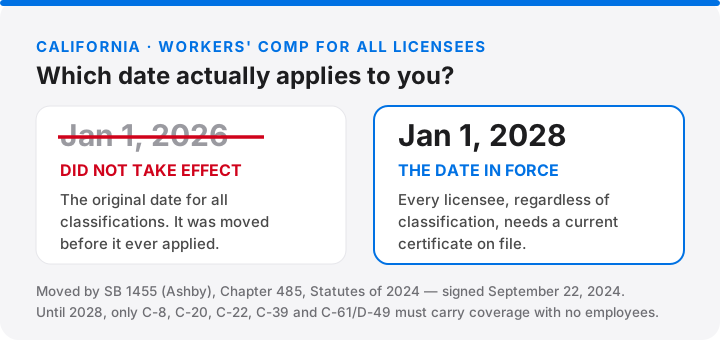
Is workers' comp required for all California contractors in 2026?
No. The universal requirement is not in effect. The confusion is real and it has a cause: the 2026 date was the law for about two years before it was moved, and a lot of pages written in 2023 and 2024 were never updated.
The actual sequence, with the bill behind each step:
| Date | What happens | Authority |
|---|---|---|
| Jan 1, 2023 | C-8 concrete, C-20 warm-air heating/ventilating/air-conditioning, C-22 asbestos abatement and D-49 tree service must carry workers' comp even with no employees. C-39 roofing was already required under prior law. | SB 216 (Dodd), Ch. 978, Stats. 2022 |
| Jan 1, 2026 | Original date for all classifications. Did not take effect. | SB 216, superseded by SB 1455 |
| In force now | Minimum civil penalty of $10,000 per violation for a sole owner licensee found to have employed workers without maintaining workers' comp coverage, and $20,000 per violation for a partnership, corporation, LLC or tribal business licensee. | SB 291, Ch. 455, Stats. 2025 (signed Oct 7, 2025; the amended section carries no delayed operative date) |
| July 1, 2026 | CSLB's general minimum civil penalties rise: not less than $1,500 for violations involving unlicensed persons, and not less than $500 or $1,500 for other violations depending on the section. CSLB may adjust these for inflation every five years. | SB 779, Ch. 233, Stats. 2025 |
| Jan 1, 2027 | CSLB must have an exemption-verification process established, and must report its proposed process to the Legislature. | SB 1455 and SB 291 |
| Jan 1, 2028 | All licensees, regardless of classification, must have a current Certificate of Workers' Compensation Insurance or Certification of Self-Insurance on file as a condition of issuing, reinstating, reactivating, renewing or maintaining a license. | SB 1455 — the bill text reads: "This section shall become operative on January 1, 2028." |
Which classifications must carry workers' comp right now?
Five. CSLB states it plainly on its own page: "All active C-8 Concrete contractors, C-20 Warm-Air Heating, Ventilating and Air-Conditioning contractors, C-22 Asbestos Abatement contractors, C-39 Roofing contractors, and/or C-61/D-49 Tree Service contractors are required to carry workers' compensation insurance" — employees or not.
If you hold one of those five, the no-employees exemption is not available to you and never was. If you hold anything else and genuinely have no employees, you can still file the exemption today.
Two things worth knowing regardless of classification. A lapse in coverage suspends the license automatically, and per CSLB, "Any work performed while the license is suspended is considered to be unlicensed." That is the trap that costs the most, because the suspension happens on the insurer's cancellation notice, not on a letter you remember opening.
What actually changed in 2026?
The penalties, not the mandate. SB 291 wrote minimum civil penalties into Business and Professions Code section 7125.4 for employing workers without maintaining coverage: $10,000 per violation for a sole owner, $20,000 per violation for a partnership, corporation, LLC or tribal business. There is no discretion below the floor.
Read who that hits. It is not aimed at the contractor who has a crew and a policy. It is aimed at the licensee who filed a no-employees exemption and then put somebody on a job — the helper for a weekend, the nephew on the tear-out, the day labor for the heavy lift. That was always a violation. As of this year it starts at five figures.
Separately, SB 779 raised CSLB's general minimum civil penalties as of July 1, 2026, and its amended section 7099.2 sets the band for section 7125.4-related violations at not less than $1,500 and not more than $30,000. Both statutes are on the books and they overlap. What any particular case is actually exposed to is a question for a lawyer, not for a blog post — including this one.
Can I still file the "no employees" exemption?
Yes, if you don't hold one of the five classifications above. You provide CSLB with a signed exemption certifying that you have no employees at this time, by downloading the form or ordering Form #32 from CSLB.
You cannot file it if you have employees, if you hold a Responsible Managing Employee qualification on the license, or if the license is in one of the five mandatory classifications. Those are CSLB's stated bars, not interpretation.
How will CSLB verify the exemption?
This is the part no one is writing about, and it is the part that decides whether the exemption is still a realistic plan for you.
SB 1455 gave CSLB until January 1, 2027 to build a verification process — an audit, proof, or other means of confirming that a licensee claiming no employees actually has none. SB 291 required CSLB to report its proposed process to the Legislature by the same date. The board authorized that report at its March 19, 2026 meeting.
According to the University of San Diego's Center for Public Interest Law, which summarized the report, CSLB proposed:
- A dedicated Workers' Compensation Insurance Enforcement Unit of roughly 17 staff, at an estimated cost of about $2.8 million.
- A recurring $500 filing and recertification fee, due every two years at license renewal, to fund it.
- A business plan from the licensee demonstrating the factual basis for claiming the exemption, plus an acknowledgment of the requirements and penalties.
- Auditing about five percent of exemptions annually, rather than every renewal, plus review of consumer complaints for signs of misuse.
And the number that should change how you plan: CSLB's Registrar estimated that roughly 9 to 10 percent of licensees would qualify for the exemption at all.
None of that is law yet. It is a proposal to the Legislature and it can change. But it tells you the direction with unusual clarity: the exemption is being turned from a checkbox into a filing with a fee, a business plan, and an audit risk — and the agency writing it does not expect most licensees to qualify.
What should I do between now and January 1, 2028?
- Look up your own license today. Run it through CSLB's Check a License tool and read the workers' comp line. If it says exempt and you have used any paid help since you filed, that gap is the expensive one.
- Fix the paid-help problem first, not the 2028 problem. The 2028 mandate costs you a premium. Employing an uninsured worker now costs a $10,000 minimum. Those are not the same order of risk.
- Get a quote now rather than in late 2027. CSLB does not set the price; carriers do, by classification and payroll. Ask a licensed broker what your class code actually costs before you assume you can't afford it. Anyone quoting you a single statewide number for "a one-man operation" is guessing.
- Watch your cancellation notices like they are license notices, because they are. A coverage lapse suspends the license on its own.
- Re-check in early 2027, when CSLB's verification process is due to be established. That is when the exemption's real paperwork becomes visible.
Why does so much of the internet still say January 1, 2026?
Two different errors, pulling in opposite directions, and it is worth being able to spot both.
The first is simple staleness. Pages written in 2023 and 2024 correctly reported the SB 216 timeline, and were never revised after SB 1455 moved it. Reasonable at the time, wrong now.
The second is more slippery: pages that acknowledge the 2028 date and then add that the 2026 date "isn't nullified" and marks the start of "full enforcement." No statute says that. What is true is that 2026 brought real changes — the SB 291 penalty floors and the SB 779 minimums — so a reader who half-remembers a 2026 deadline is not hallucinating, just merging two different things. The opposite error is just as costly: concluding there is nothing to do until 2028, while the penalty for employing an uninsured worker sits at $10,000.
Everything above is drawn from the bill text at the California Legislature's site and from CSLB's own workers' compensation page, both linked so you can check them yourself. This is not legal advice, and CSLB is the authority on your license — not us. If your situation is close to a line, pay a lawyer or a licensed broker for an hour.
One note if you are not licensed yet: these obligations attach from the day the licence issues, not from the day you hire your first employee. That is the part most people find out late. 工地老张 teaches how the licence itself works, in Chinese, from the exam onward.
FAQ
Do all California contractors need workers' compensation insurance in 2026?
No. The requirement for all classifications regardless of employees was moved from January 1, 2026 to January 1, 2028 by SB 1455 (Chapter 485, Statutes of 2024). Right now only C-8, C-20, C-22, C-39 and C-61/D-49 licensees must carry coverage with no employees. Everyone else can still file the no-employees exemption with CSLB.
When do all California contractors need workers' comp?
January 1, 2028. SB 1455's operative language is explicit: "This section shall become operative on January 1, 2028." From that date a current Certificate of Workers' Compensation Insurance or Certification of Self-Insurance is a condition of issuing, reinstating, reactivating, renewing or maintaining a license.
What is the penalty for a California contractor employing workers without workers' comp?
SB 291 (Chapter 455, Statutes of 2025) set a minimum civil penalty of $10,000 per violation for a sole owner licensee found to have employed workers without maintaining coverage, and $20,000 per violation for a partnership, corporation, LLC or tribal business licensee. Separately, a lapse in required coverage suspends the license, and CSLB states that work performed while suspended is considered unlicensed.
Can I still claim the no-employees exemption from workers' comp?
Yes, unless you hold a C-8, C-20, C-22, C-39 or C-61/D-49 license, have employees, or hold a Responsible Managing Employee qualification on the license. You file a signed exemption with CSLB certifying that you have no employees at this time, using CSLB's downloadable form or Form #32.
Is CSLB going to start checking workers' comp exemptions?
That is the plan. SB 1455 requires a verification process to be established by January 1, 2027 and SB 291 required CSLB to report its proposed process to the Legislature by the same date; the board authorized that report on March 19, 2026. As summarized by the University of San Diego's Center for Public Interest Law, CSLB proposed a dedicated enforcement unit, a recurring $500 filing and recertification fee every two years, a business plan from the licensee, and annual audits of about five percent of exemptions. It is a proposal, not law yet.
Does a minimum-premium or "ghost" policy satisfy the requirement?
Whether a particular policy satisfies CSLB's proof-of-coverage requirement for your license and classification is a question for a licensed broker, and CSLB is the authority on what it will accept on file. What is not ambiguous: the $10,000 and $20,000 minimum penalties in SB 291 attach to employing workers without maintaining coverage, so no policy structure makes uninsured paid help safe.